Introduction
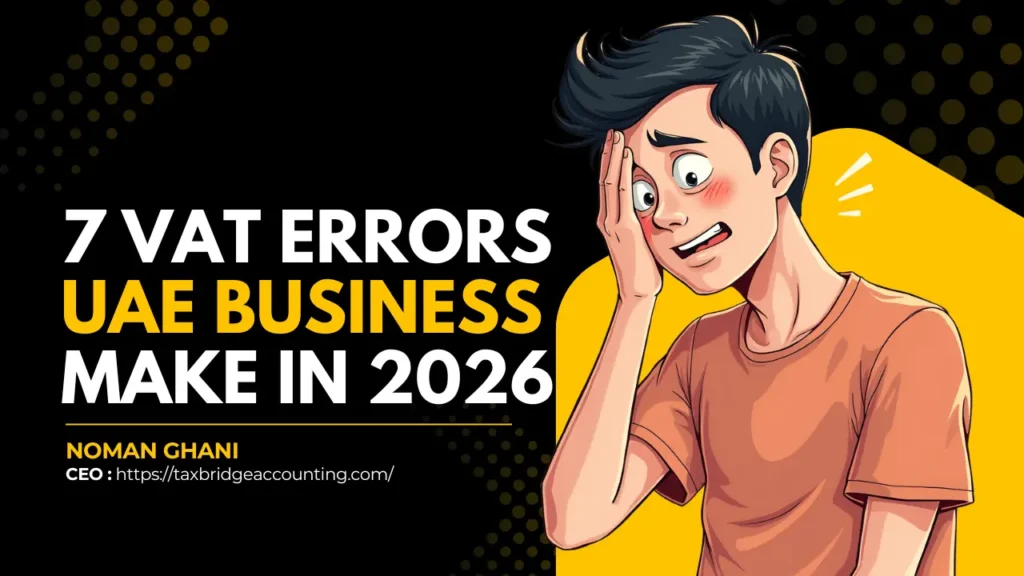
VAT calculation errors UAE businesses make are often silent at first—but expensive later.
Since VAT was introduced in the UAE in 2018 at a standard 5% rate, many businesses assume compliance is simple. But in reality, even a small miscalculation can trigger FTA scrutiny, incorrect filings, or penalties that exceed AED 10,000.
The Federal Tax Authority (FTA) has tightened its enforcement framework in 2026, making accuracy more important than ever. According to the UAE government tax portal (https://tax.gov.ae), proper VAT reporting is a legal obligation for all registered businesses.
In this guide, we break down the 7 most common VAT calculation errors UAE businesses make and how to avoid them before they become financial liabilities.
What This Blog Covers
In this guide, readers will learn:
- The 7 most common VAT calculation errors UAE businesses make
- Why these mistakes trigger FTA penalties
- Real-world VAT calculation examples
- Practical ways to stay compliant
- How to reduce audit risks in 2026
1. Calculating VAT on the Wrong Base Amount
One of the most common VAT calculation errors UAE businesses make is applying VAT on the wrong base.
For example, businesses sometimes calculate 5% VAT on an already VAT-inclusive amount, inflating totals incorrectly. This small error multiplies across hundreds of invoices.
Correct VAT must always be applied to the taxable base only, not the final invoice amount.
To avoid this issue, businesses should use accounting systems like QuickBooks or Zoho Books that automatically apply correct VAT logic. Training staff is equally important.
2. Misclassifying VAT Rates (5%, Zero-Rated, Exempt)
Another critical VAT calculation errors UAE issue is misclassification.
Zero-rated supplies (0%) still allow input VAT recovery, while exempt supplies do not. Confusing the two leads to incorrect VAT returns and compliance risks.
For example, some healthcare services may be zero-rated while education services are exempt—mixing them up creates filing errors.
Businesses should maintain a VAT classification sheet for all services and regularly review it.
03 – Claiming VAT on Non-Recoverable Expenses
Many companies unknowingly commit VAT calculation errors UAE by claiming VAT on blocked expenses.
These include:
- Entertainment expenses
- Employee benefits
- Non-business gifts
FTA regulations clearly restrict VAT recovery on such costs.
To avoid penalties, businesses must separate eligible and non-eligible expenses at the bookkeeping stage itself.
Regular internal audits help prevent these hidden VAT mistakes.
4. Ignoring Reverse Charge Mechanism (RCM)
One of the most overlooked VAT calculation errors UAE companies face is failing to apply the Reverse Charge Mechanism.
When importing services or goods from outside the UAE, businesses must self-account for VAT.
Failure to record RCM leads to underreported VAT liability and potential audit exposure.
Companies should ensure all international transactions are flagged and recorded properly in their accounting systems.
4. Including VAT in the Invoice Base When Calculating Output VAT
This is a reverse version of earlier mistakes and a major VAT calculation errors UAE issue.
Some businesses treat VAT-inclusive amounts as if they are net values, leading to incorrect calculations.
For example:
If an invoice is AED 100 inclusive of VAT, the actual taxable amount is AED 95.24—not AED 100.
Incorrect interpretation leads to underreporting VAT.
Automated invoicing systems help eliminate this issue completely.
6. Recording Transactions in the Wrong Tax Period
Timing is everything in VAT compliance.
Many VAT calculation errors UAE businesses make involve recording invoices in the wrong VAT period.
VAT must be reported based on invoice date, not payment date. Misalignment creates inconsistencies in filings.
Monthly reconciliation ensures transactions match the correct reporting period and prevents FTA queries.
7. Failing to Reconcile VAT Returns Before Submission
One of the most dangerous VAT calculation errors UAE companies make is skipping reconciliation before filing.
When accounting records don’t match VAT returns, it raises immediate red flags during audits.
Businesses should always compare:
- VAT return data
- Accounting ledgers
- Sales and purchase records
A final review before submission reduces audit risk significantly.
UAE VAT Penalty Framework (Effective April 2026)
Why businesses must understand penalty exposure in 2026.
Penalty Table
| Violation | Penalty |
| Incorrect tax return | AED 1,000 first time / AED 2,000 repeat |
| Failure to pay VAT | 2% immediately + monthly penalties |
| Late VAT registration | AED 10,000 |
| Failure to update records | AED 5,000 to AED 10,000 |
| Wrong filing after audit | AED 500 + 15% unpaid tax + monthly penalties |
Practical VAT Compliance Checklist for UAE Businesses
Checklist Items
- Use FTA-compliant accounting software
- Reconcile VAT monthly
- Verify VAT classifications
- Review blocked expenses
- Track imported services
- Conduct quarterly VAT reviews
- Train finance teams regularly
When Should You Hire a VAT Consultant?
Signs Your Business Needs Help
- Multiple VAT amendments
- Rapid business growth
- Cross-border transactions
- FTA notices or audits
- Complex expense structures
Benefits of Professional VAT Support
- Reduced audit risk
- Accurate filing
- Better documentation
- Peace of mind
References / Sources
Conclusion
VAT calculation errors UAE businesses make are rarely intentional but always costly.
With the FTA tightening compliance rules in 2026, even small mistakes can escalate into major penalties exceeding AED 10,000.
The solution is not complexity, it’s consistency, automation, and awareness.
So here’s a question for you:
👉 Have you ever faced a VAT calculation error or penalty in your business and what did it teach you? If need help Contact us